
Last updated on 05/08/2026
In which we’ll catch the conscience of the king, I guess. Look, wordplay is hard, and I want to talk about ways of solo roleplaying. Not systems or methodologies per se, but like, the how it’s done. Maybe we’ll even touch on the why here a second.
If you, like me, are a woman of a certain age, then you’ll have seen the following meme: enough bad rectangle (office computer), time for good rectangle (home computer or console). Like all jokes, there’s a kernel of truth here, and it has hit me directly.
I’m an academic by training and trade. I write code for a living. And e-mails. So many fucking emails. Also the occasional research paper. I spend a lot of time on the computer professionally, is what I’m getting at. Tragically, I’m also an enjoyer of video games. So sometimes, when I get home, I switch from bad rectangle to good rectangle. For gaming, video games or ttrpgs, for writing, and for tvs or movie.
Can We Have One Non-Computer Thing, Please?
Sometimes, though, sometimes, a girl wants to get away from it all. A meme from a younger generation, but it checks out:

Sometimes you need to touch grass. Or just, you know, not look at a screen for five fucking seconds. This is, presumably, where I show you my sweet solo ttrpg setup. Dear reader, it is a fucking notebook. A nice one, because nice stationery is a joy on its own, but it’s just a notebook. It’s dotted A5, with a ribbon or two in it for keeping my place, the paper is heavy enough that the pens don’t bleed through, and that is all it needs to be. The current notebook has a few index pages up front, and the pages are numbered, which is nice, but that’s all shit I could do on my own.
The Advantages of Analog Medium
It Does Exactly One Thing
Beyond the need for a change of pace, there are serious advantages to the analog medium, by which I mean playing in a notebook and taking notes with pens. The largest is that the notebook, for me, provides me with focus. My ttrpg notebooks are for that. They’re not a multi-purpose device where I can do anything. This notebook is for that ongoing game, and that notebook is for a different one, and that notebook is for my diary, and so on.
That “trick” of having task-focused artifacts may not work for you. If it doesn’t, then truly, I am so sorry. Still, there are other advantages to non-digital. Here’s a picture from a recent scene.
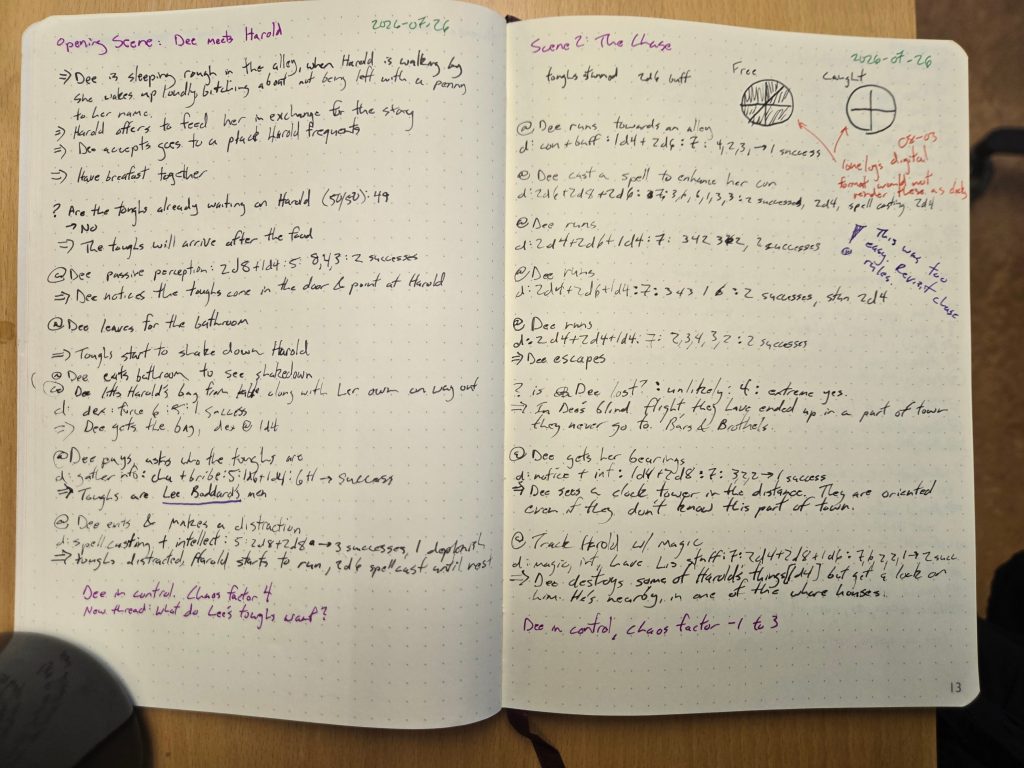
I want to draw your attention to the upper right page. It’s a clock, which is a mechanism I was introduced to via Forged in the Dark systems, but one which has seen wider adoption in other places because it’s a damned good idea. For the uninitiated, complex actions need more than one success to achieve, and multiple clocks might be running simultaneously.
I guess the second thing to draw your attention to is the shorthand. I’m abusing lonelog, in so much as I understand the notation poorly, and as I’m not looking to have it successfully go through a parser, it doesn’t need to be perfect. In short, lonelog is a short markup language for taking notes about an ongoing roleplaying game. It captures things like questions, dice rolls, outcomes, and elements in the fiction in repeatable, compact ways. Really a godsend for note taking on games, honestly. I truly write less when I use it, which is mostly, but not universally good. We’ll come back to that idea at the end, but to wit – I like that lone log helps me take notes quickly, but a big part of the solo exercise to me is to encourage me to write more, and lonelog’s format encourages me to write less.
It Gets Out of the Way of Doing the One Thing
In this scene, I modeled a chase as two competing clocks, thugs vs heroes. Could have also been done as a tug of war, but I digress. I don’t care what your setup is, you don’t have a digital clock entry that is as convenient and eye-grabbing as the one on my fucking page. Or maybe you do, but I cannot be bothered to learn yet another markup language in order to keep track of the clock and have it render correctly in obsidian or whatever augmented text editor we’re using these days. Drawing a circle and segmenting it is nearly free. There is just no friction there, and it floats at the beginning of the scene in the margin, or right where it was introduced as I see fit.
Clocks are the simplest use cases. Maps. Character portraits. Sketches of items. Honestly, anything that has a cleaner representation than strings of text is easier to do on paper. For me. Maybe you’re a digital artist as your day job, and drawing on your computer is the most natural thing in the world. More power to you, but not my experience, nor, I suspect, the experience of most folks in the hobby.
No Strings Attached
Finally, the obvious. Stationary doesn’t run out of power. It works on the road, in a blackout (provided you have a light source), on the plane, on the train, in the woods, for as long as you can see it. If you have the itch, and you want to play, you can just pick up your tools and get to it. I can pack it and play a few rounds when I stop after an evening of hiking, or more frequently, when I only have so many power converters for wherever my travels have most recently taken me. On the flight angle specifically, most of my electronic devices are cumbersome on a plane in a way a notebook is not. It’s honestly more considerate of the shared space, which is a plus.
What Digital Brings to the Table
It’s not all frolicking through the wilds with a nice notebook and some decent pens, unfortunately. There’s a lot you lose in analog settings. The biggest hurdle is honestly the weight issue. Dice take up space. Books are heavy and cumbersome. With the bare minimum, say a single source manual, mythic GME, some dice, the notebook, and some pens, you’re already talking about a couple of pounds and considerable bag space. And if you need multiple manuals, or play more than one system, or whatever, well, it’s a lot. Even if like me you’ve memorized most of your systems rules, it’s not 0 space, so that sucks.
If we ignore the space and weight of the dice, just simply rolling dice is a struggle all its own in some settings. Planes, trains and automobiles is more than a kickass movie. They’re also a rude place to roll dice and have one go skittering all over the place. An app is a fine replacement, but it’s still a digital thing.
As much as I prefer dead tree for reading, I have to admit digital manuals have one extremely large benefit. Indexability. No glossary or index will ever beat the most modest search functionality in a pdf reader. What was that rule? 5 second lookup, tops. I probably need more time to read the page than find it, and that sucks to give up.
Keeping my play logs digitally had three major advantages I noticed over notebook play:
- I wrote more
- I couldn’t lose my game
- I could share the game easily
So, I keep my solo game logs as markdown files. That means they’re super easy to put into source control, where they take up no space and can be downloaded to as many devices as I want. Having physically mislaid the notebook with a campaign in it, it’s a hard experience. Git fixes it. Also, having the text digitally means two things: my hands won’t fucking cramp, and the text copies easy onto a blog, or discord.
Here, check out two similar scenes, side by side:
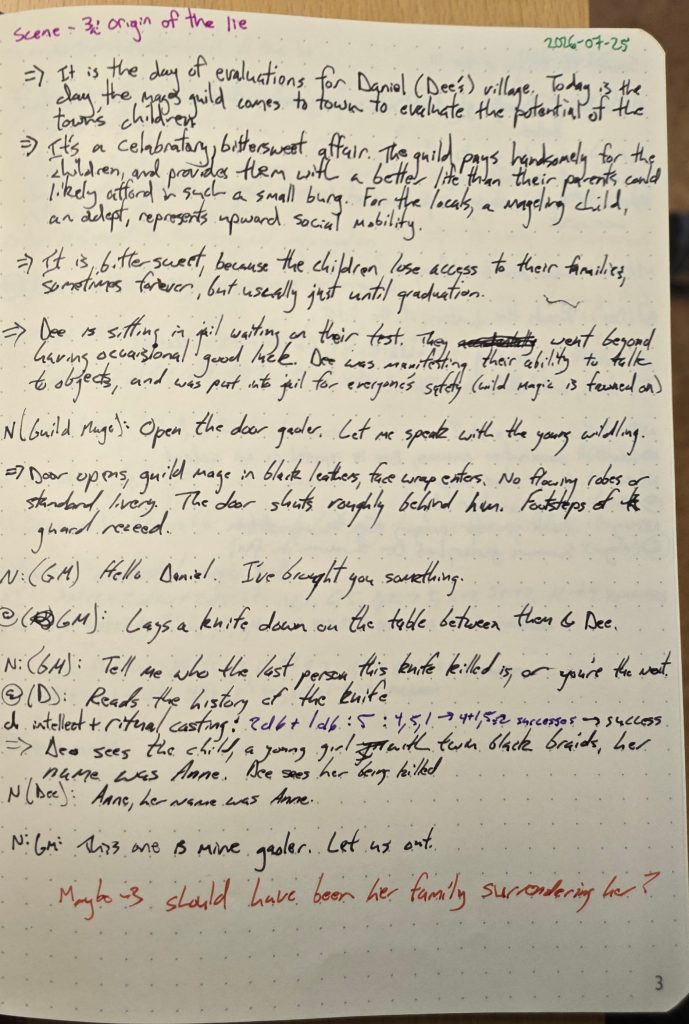
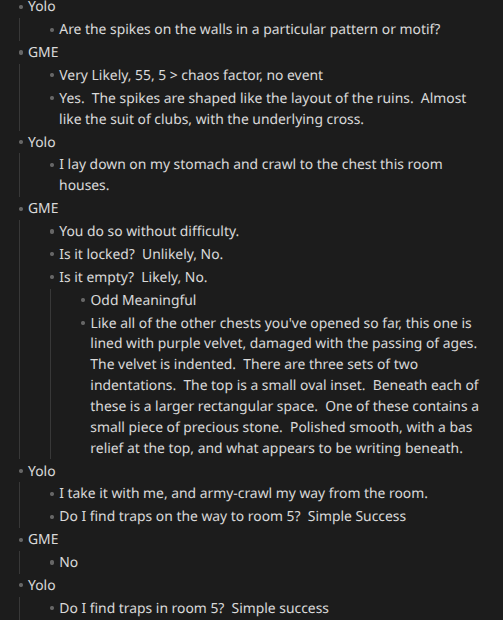
One is basically an adventure serial. The other is barely an outline for it. As someone who honest-to-god likes writing, I feel like I’m losing something when I play analog, simply because I cannot be bothered to write that much text down regularly. If I do write so verbosely, I still have a lot of work before I can show it off broadly. OCR solutions are good, but they aren’t as good as my handwriting is shitty.
A Foolish Consistency is the Hobgoblin of Little Minds
The ideal solution isn’t to follow either dogmatically, in my experience. I do exactly the thing you might expect given the above. I have small cheat sheet references for Mythic scene transitions and probability tables. I keep my manuals on a digital device (typically a table or my phone), and a dice rolling app along side it. That gives me most of what I want without spending all of my time with a screen or risking constant distraction.
The big point of friction is actually how much fiction gets included. I have yet to find the solution here. I’m here for the writing, more or less, in solo games. I view them as something midway between creative exercise and meditative practice, and so the point of solo play, for me, is to disconnect and write and draw and imagine more. Analog tools help with the disconnection portion of the equation, but, vexingly, they have me writing less.
As that’s a big part of the experience for me, I need to find a way to add it back in. There are three options I’ve tried, and they all work-ish:
- Go back and write scenes long form after playing them before moving on to the next scene
- Treat the analog scene shorthand as an outline for long form digital writing
- Do an epistolary thing, like an adventurer’s journal, during downtime
They all work; they all have drawbacks. 1 and 2 require me to go do something that isn’t “playing the game” when I come back to play the game if I’m not careful. Writing is part of play for me, but even I don’t feel like it’s playing the game sometimes.
The epistolary approach fixes some of this. A campfire (or other downtime scene) acts as a natural break point for a character to summarize their thoughts and reflect. It provides a summary for future me to figure out where I was, and how the character felt at the moment. It’s still not a fully written scene for every scene of play. Less is less, in a very un-unix way. Still, it’s writing, and it gets out of the way of play. It’s probably where I’ll stay so long as I’m playing bookish characters that seem like the sort of asshole that would take their journal into a life or death survival situation.
Jesus, I lost the plot
I had a point in there somewhere. I think. Besides how much writing is appropriate in non-journaling solo ttrpgs, I mean. I got lost somewhere along the way. Anyway, I think solo games should be played in a mixed medium. Assuming you got this far, you give a damn about my opinion, so here’s what I recommend:
- Use physical dice where you can, an app where you can’t.
- Keep a notebook at hand for writing and sketching.
- Set your beverage on top of your phone to keep you from doing more on it than looking up source manuals.
Paper is an ideal tool; it gets out of the way of the playing and encourages what I see as the main benefits of the exercise: unplugging and doing creative things. The difficulty in sharing the output cuts both ways. It’s hard to share, but having something that’s just for you is also freeing.