
Last updated on 22/09/2026
I got into a weird argument with my wife a few weeks ago. Or years, you know, depending on when you happen across these words. Writing is strange like that. Anyway, we got into, well maybe a debate is more accurate? We got into a discourse about the nature of art.
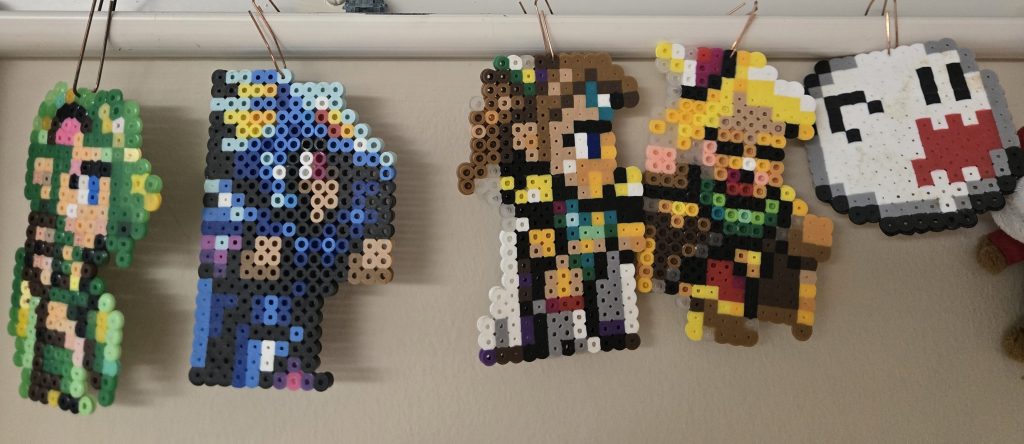
I sometimes convert sprites from NES and SNES games into perler bead crafts. I give them to friends, I put them up in my office. Sometimes they end up being labor intensive coasters. It is my firm belief that these things are not, in a very meaningful sense, art. It’s my wife’s firm belief that this makes me a wrong-headed asshole. The argument goes something like this:
“But there’s no fucking thought in it. I look at the sprite sheet, count the pixels, match the colors, then iron the thing.”
“But you chose a scale. You found the adjacent colors. You picked the fucking medium. It’s literally transformative.”
“But it isn’t enough! It’s a completely mechanical transformation. I could build a pick & place to do this.”
And on and on it goes. Eventually one of us yells about Warhol and storms out of the room. I mean, not really, we don’t really yell or storm out of rooms, but it makes for a good story, doesn’t it? The part up through me arguing that it’s a mechanical transformation is true though.
I really do think that medium and scale isn’t enough. If I’d done this on a wall in post it notes, that wouldn’t have been enough either, at least not in my mind. Let me show you another piece of mine where i think it’s absolutely art.
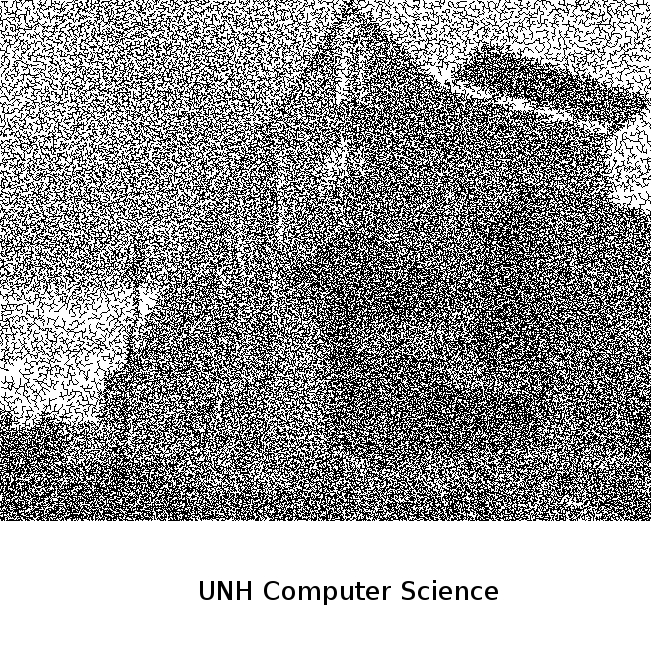
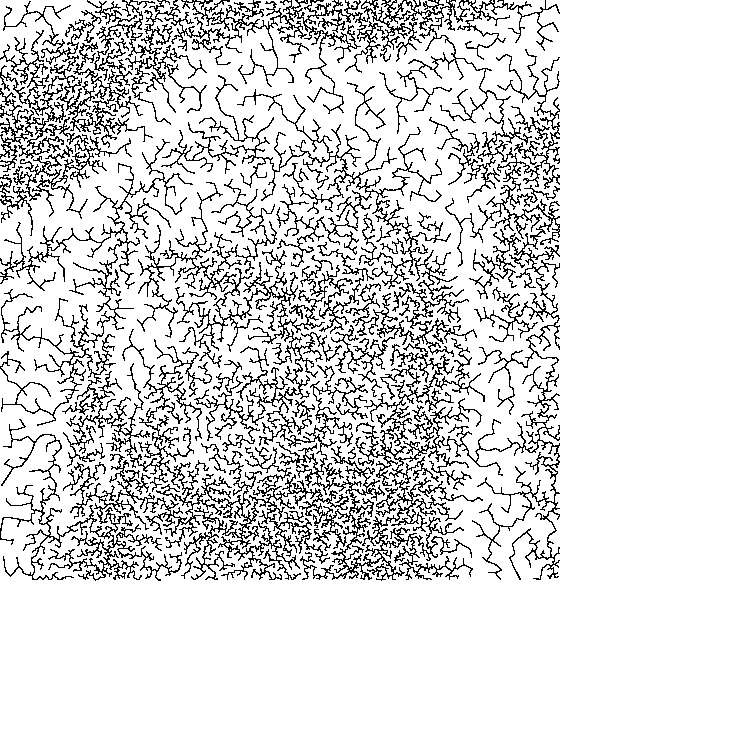
I did both of these during my PhD at the University of New Hampshire (the building there is Kingsbury Hall, where the CS department is). They’re actually both pieces I did as part of the algorithms course I was teaching, as they need some computation for their construction. Here’s how it works:
- Get a grayscale image
- Set a resolution
- For each ‘cell’ in the image, sample points randomly within it based on how dark it is
- Take the set of points and compute the minimum spanning tree of the points
- Render the image
So, steps 1-3 effectively take a black and white picture and render it as a pointillist piece. I mean, not really, because there’s no notion of the fineness of the points, the pressure applied, and so on. What do you want from me? I’m a computer scientist, not an art major.
Anyway, the first few steps give you an approximation of a pointillist piece, but they also give you a large set of points in a 2D plane. Any collection of points can be turned into graph by adding edges between all pairs of points with weight equal to the distance between them. So, at this point we have a weighted graph, and we can run the minimum spanning tree algorithm. This is the algorithm I was trying to get my students to give a shit about, but it is also an algorithm for computing the cheapest collection of edges that will connect all nodes in the graph.
If you render those, you get the image above. I also did some cheapest tours of all points (the traveling salesperson problem), but those images are lost to time at this point. Anyway, what you get is a different black and white image than the one you started with. It is, as my darling wife would say, transformed.
I am decidedly unbothered by the notion that the algorithmic transformation above is art. “Why?!” I hear you cry, you convenient rhetorical device you. Well, because it wasn’t sold to me for a fucking start. I have some thoughts on commercialized arts and crafts we’ll get to in a second. The more important bit though is because the mechanical transformation required some actual goddamned thought.
I don’t mean “because algorithms are hard.” You can go do this shit right now. There are a billion implementations of spanning trees on github. Honestly, an hour slaving over a python buffer and occasionally referencing CLRS should get you there. It’s not the labor that matters. If it was, the perler beads would certainly count. That shit takes forever.
No, it’s a non-obvious application of the algorithm. Spanning trees are the baseline heuristic in the TSP. They’ve got some other neat uses in graph algorithms for helping you decide how to partition or cluster or whatever. That’s all set theory and math though. The hard part is marrying the two. That little moment of “Hey, you know what might look sick as hell?” followed by 30 minutes of furious implementation and a little giddiness as you point the thing at the first image.
I might be pleased with the artifact that comes out of messing around with perler beads. I mean, truthfully, I often am. I love the videogames I do the sprites from, seeing the little tchotchkes in my office brings me joy, and it gives me and my students something to bond over. That pleasure will never, ever be surprise though. When I started with the perler beads I had a vision in mind and knew with perfect certainty that it could be reproduced. Even though I knew the algorithmic transformations of my MST pictures could work, and I had a sense of how they might look when rendered, I was still surprised by the outcome. I learned something in making them.
Let me turn to another brilliant piece of algorithmic art: King James Programming. For the uninitiated, KJP combines the king james flavor of the bible and “The Structure and Interpretation of Computer Programs” into a markov babbler. What’s a markov babbler you ask? Well, it’s a next-word predictor. Think of it as the tinier, older, non-ocean-boiling progenitor of modern LLMs. A markov babbler looks at all sequences of words in a given body of text and writes down how frequently one word appears after another. A little bit of creative representation, and it is not hard to generate random utterances that have the flavor of the original texts. When you combine that with heavy curation, you get some real fucking gems like the following:
Then they shall call upon me, but I will not cause any information to be accumulated on the stack.
Maybe you had to be there, but there was a time and place (namely the early 00s internet) where this was a performance-art banger. I still think it’s pretty funny, but I’m the target audience. It is, at the end of the day, an amalgamation of two source texts. Still, the curation, both in choosing the source texts as well as in selecting which outputs to show the audience make this art too.
And, critically, they make it art in ways that invoking an LLM is not art. Prompting is a skill that can be improved. So is programming, but so is picking and placing perler beads. Being a developable skill and requiring labor are insufficient for something being art, at least if you buy my prior arguments. LLM output is also curated like KJP output was, so that can’t be the necessary criteria either.
The key difference between an LLM mashup of texts and KJP is that whoever did KJP had profound control over it. Why the KJV and not the NIV? Because the KJV version is way funnier than a modernized bible would have been. Why Structure and Interpretation and not Simply Scheme, or the Dragon Compilers Book? Well, I assume because it has a fucking wizard on the cover, and that spoke to the artist just as it does to me. Someone looked at the available choices, licked their thumb, tested the wind, and said “This shit will get the nerds rotfloling.”
The critical difference is in control, choice, and agency. Unless you are steering a handful of major corporations, or are an incredibly invested hobbyist, you have no meaningful control over LLMs. More directly, prompting, RAG inputs, none of that is meaningful control over the LLM. Training is meaningful control, and most people reading this aren’t going to be doing that, not even fine-tuning.
In the spanning tree visualizations, I had my choice of algorithms for generating a connected version of the vertexes in my graph: minimum tour, spanning tree, random walk. MST got chosen because I knew it would look good. The perler beads have no choice by comparison; they are mechanical transformations of two inputs. They produce a pleasing output.
A few last examples, to drive the point home I swear. In our roving argument, I learned the term “diamond painting”. Diamond paintings are, well, effectively some-assembly-required wall art. You get a canvas that’s back-colored, lightly gridded, and marked with what piece goes in each cell. You also get a large collection of bits to put into the canvas. Once you’re done, you’ve got a pretty picture to hang on your wall or set on your desk. Like the perler beads, I’ve got no doubt this can be a fulfilling meditative exercise, but, well, there’s just no agency or choice involved.
Compare that to mad libs. Every child playing mad libs knows the reason it’s fun and that it’s funny is that they’re being subversive. Most kids won’t know to use that language, but that’s why mad libs are a gas. Yes, we’re just plugging a few words into some holes, but that has agency in a way placing one piece of plastic onto another doesn’t.
There’s nothing subversive in LLM output. There’s nothing angry, or sad, or exciting, or confusing. It is perfectly devoid of emotion because it’s devoid of intention. Even the perler beads had that, and a reverence for the original properties.
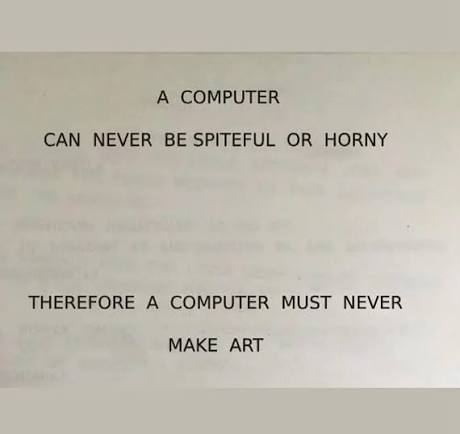
Yes, the prompt could be sufficiently angry or horny, but the prompter doesn’t do the work. The immense machinery of the LLM does the work. Since the prompter can’t control that materially, the output is exactly as emotionally rich as the search results from an incredibly thirsty query in an incognito window. Momentarily satisfying, but ultimately devoid of meaning and maybe a little embarrassing.
And that, ultimately, is the point. Art, as I understand it, is the desperate screaming of a person against the reality that two minds can never truly know each other. Art is an effort to communicate something about one’s self both internally and externally. For it to land, there’s got to be intent and emotion. The artist needs agency and agency requires choice and decision making. perler beads, diamond painting, and LLMs all fundamentally rob a person of too much agency for the results to count as art, even if the outputs are aesthetically pleasing.